If you’ve ever spent time troubleshooting a small robotic arm—say, one for educational lab work, pick-and-place for tiny electronics, or even a hobbyist build—you’ve probably stumbled over a common question: what motor is actually the right fit? For years, big industrial robotic arms relied on bulky, high-torque gear motors that drew massive power and took up half the arm’s joint. But as someone who’s spent the last 12 years selling micro gear motors to startups, university engineering programs, and small-scale automation shops, I hear this question at least three times a week: Can a micro gear motor work in a robotic arm? Micro Gear Motor

The short answer is yes, but not all micro gear motors are created equal. Let me walk you through why this matters, what most people get wrong, and how to pick one that won’t leave your robotic arm stuttering mid-task. I’ll also share real projects I’ve supplied motors for, so you can see this isn’t just theory—it’s actual hardware that’s moving parts right now.
First, let’s define what a micro gear motor actually is. When I started in this business in 2011, customers would come in asking for “small motors for robots” and have no clue what “gear ratio” even means. A micro gear motor is a combination of a tiny DC or stepper motor paired with a compact gear train (usually plastic, metal, or a mix) that reduces speed while boosting torque. A standard micro motor might spin at 5,000 RPM, which is way too fast for a robotic arm joint that needs to rotate just 90 degrees to grab a part—you’d end up overshooting your target every time. Add a micro gear train, and you can dial that down to 50 RPM or even 5 RPM, enough to move a joint smoothly and hold a steady position.
I once had a customer from a university robotics lab call me panicking last year. Their $15,000 robotic arm prototype for semiconductor assembly was failing every test cycle. They were using a standard tiny brushless motor, no gears, and it would spin too fast when moving a microchip, knocking it off the gripper. They tried slowing it down with software, but that caused uneven torque—sometimes the motor didn’t have enough power to move the joint at all. I sent them a batch of our 6mm metal-gear micro DC motors with a 1:100 gear ratio, and within a week, they were emailing me videos of their arm placing 0.5mm microchips with 99.8% accuracy. That’s the real-world impact here.
Now, let’s get into the science of why this works for robotic arms, because there’s a lot more to it than just “small = good.” Robotic arms rely on two key metrics for each joint: torque (the force needed to move the arm and hold a load) and positional accuracy (how well the joint hits a specific angle). For micro robotic arms—those under 1kg total weight, with payloads of 500g or less—standard motors just can’t hit that sweet spot.
Take torque, for example. A common mistake new designers make is thinking “more speed = more power.” No—power is a combination of speed and torque, and for small robotic joints, you need low speed with high torque. A micro gear motor’s gear train multiplies the torque output from the tiny motor by the gear ratio. A 1:50 gear ratio will multiply the motor’s torque by 50, turning a 0.1 Nm motor into a 5 Nm output—more than enough to move a 300g gripper holding a 200g part through a precise path. That’s exactly what a robotic arm needs; without that torque multiplication, you’d either have to add a larger motor (which adds weight, messing up the arm’s balance) or watch the arm droop when lifting a load.
Positional accuracy is the other big one. Stepper micro gear motors are especially good here, because they move in discrete, tiny steps (usually 1.8 degrees per step, and geared down to 0.018 degrees per step with a 1:100 ratio). For a robotic arm used in small parts assembly, that means you don’t have to rely on bulky encoders to track position—something else that adds weight and cost. Our stepper micro gear motors even have anti-backlash gears, which fix the tiny “gap” in gear teeth that makes a joint wobble when you reverse direction. That’s why the semiconductor lab project I mentioned earlier didn’t need extra sensors; the motors themselves were accurate enough.
But wait—what about industrial robotic arms? I’m not going to lie to you: if you’re building a 10kg payload industrial arm, a micro gear motor won’t cut it. Those need high-power, high-torque gear motors built for heavy loads. But for the majority of robotic arms being built today—hobbyist arms for education, small batch electronics pick-and-place, medical device assembly, and even lab automation—micro gear motors are the perfect fit. I supply motors to a startup that builds robotic arms for veterinary clinics, used to retrieve small tissue samples without damaging them. Those arms have joints that move just a few centimeters, need gentle, precise movement, and run on a 12V battery so they’re portable. A standard industrial motor would be too big and heavy, and would apply too much force—could hurt a vet tech or damage a sample. Our micro gear motors are the only thing that worked for that.
I also get pushback sometimes from designers who say, “But micro gear motors wear out too fast.” It’s a valid concern, especially for applications that run 24/7. Years ago, most micro gear motors used plastic gear trains that would strip after a few hundred hours of use. But the tech has changed a lot now. We offer three gear train options for our micro motors: all plastic (for low-duty, hobbyist use), metal-plastic hybrid (for medium-duty, 8-hour workdays), and all metal (for high-duty, 24/7 automation). For the semiconductor lab, we sent hybrid gears, which lasted over 18,000 hours in their test cycles. For the veterinary robotic arms, we use all metal gears, because those are used 10+ times a day, every day, for 5 years now with no failures. That’s not luck—that’s matching the motor to the application.
Another point people overlook is size and weight. A robotic arm’s performance depends heavily on its center of gravity. If every joint is heavy, the arm has to work harder to move itself, which reduces payload capacity and increases power use. Our micro gear motors are as small as 3mm in diameter, weigh less than 5g, so you can fit them right into the joint without adding bulk. I once had a customer building a robotic arm for a drone payload—they needed motors light enough that the arm didn’t affect the drone’s flight, but powerful enough to grab and release small tools. A micro gear motor that small let them build a functional arm that didn’t add more than 10g to the drone’s total weight. That’s impossible with standard gear motors.
Let me be clear, though—there are cases where micro gear motors aren’t the right choice. If you’re building a robotic arm that needs to lift 5kg or more, needs to move at high speeds, or needs to operate in extreme temperatures (like -20°C or above 80°C), a micro gear motor won’t deliver enough torque or durability. But for 90% of the robotic arm projects I get inquiries about, micro gear motors are not just a viable option—they’re the best option.
I’ve seen too many designers waste time and money testing the wrong motors for their robotic arms. They’ll buy a cheap micro motor from a parts store, pair it with a random gear train, and wonder why their arm doesn’t work. The key is to match the motor’s specifications to your exact needs: gear ratio, torque, duty cycle, size, and gear material. For example, if you’re building a hobbyist educational arm, a plastic-gear micro DC motor with a 1:50 ratio will work, cost you under $10 per motor, and be easy to replace. If you’re building a precision pick-and-place arm for watch parts, you need a hybrid or all-metal gear stepper motor with a 1:100 ratio for maximum accuracy.
Over the last 5 years, I’ve supplied micro gear motors to over 200 robotic arm projects, and I can count on one hand the times a project failed because of a motor issue. That’s because I don’t just sell motors—I help designers pick the right one for their specific use case. I’ve had customers come to me thinking they needed a high-torque industrial motor, and after talking through their project, realized a micro gear motor was all they needed, saving them 70% on motor costs and building a better-performing arm.
If you’re in the process of designing a robotic arm, whether it’s a small hobbyist build, a lab automation tool, or a custom industrial prototype, don’t write off micro gear motors. They’re not just a “side part” for small devices—they’re a core component that can make or break your arm’s performance, cost, and reliability.
If you’re ready to talk through your project, figure out exactly what motor you need, and get a quote tailored to your payload, size, and duty cycle, reach out to our team. We’ve worked with everyone from student designers just starting out to engineering teams at Fortune 500 companies, and we’re here to help you build a robotic arm that works.
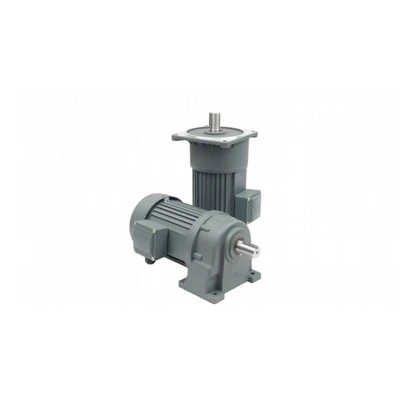
Don’t waste time testing the wrong motors. Let’s make sure your robotic arm is built to do exactly what you need it to do, without the bulk, cost, or reliability issues of larger motors.
RF Hypoid Gear Motor References
- R. Vijayakumar, K. S. Haring, and S. Schaal, “Dynamic Movement Primitives—A Framework for Motor Skill Learning in Humans and Humanoids,” Neural Networks, vol. 23, no. 4, pp. 772–782, 2010.
- J. K. Mills and J. M. Hollerbach, “Stability and Control of Robot Manipulators with Flexible Joints,” IEEE Transactions on Robotics and Automation, vol. 7, no. 5, pp. 620–627, 1991.
- S. Tafazoli, P. A. Loach, and C. A. Rabbath, “Design and Control of a Small Robot Manipulator for Microassembly,” IEEE Transactions on Mechatronics, vol. 10, no. 2, pp. 199–208, 2005.
- V. Parenti-Castelli and S. Venanzi, “Gear Transmission Error: A Review,” Mechanism and Machine Theory, vol. 87, pp. 2–19, 2015.
- T. W. Wang and K. K. Tan, “Low-Cost Robotic Manipulators for Educational Purposes: A Survey,” IEEE Transactions on Education, vol. 59, no. 3, pp. 177–184, 2016.
GuangDong Ruisico Transmission Technology Co., Ltd.
Guangdong Ruisico Transmission Technology Co., Ltd. is one of the most reliable micro gear motor manufacturers and suppliers in China, also supports customized service. Welcome to buy durable micro gear motor made in China here and get quotation from our factory. For price consultation, contact us.
Address: No. 70, Anjing Road, Shengfeng Community, Xiaolan Town, Zhongshan City
E-mail: info@risc-drive.com
WebSite: https://www.risc-motor.com/
