Measuring three – phase power accurately is crucial in many industrial and commercial applications. As a supplier of multi – function meters, I have witnessed firsthand the importance of these devices in power measurement and management. In this blog, I will share with you how to measure three – phase power using a multi – function meter. Multi-function Meter

Understanding Three – Phase Power
Before we delve into the measurement process, it’s essential to understand what three – phase power is. Three – phase power is a type of electrical power transmission that uses three alternating currents, each with a phase difference of 120 degrees. This system is widely used in industrial and commercial settings because it provides a more constant and efficient power supply compared to single – phase power.
The power in a three – phase system can be calculated using different formulas depending on whether the load is balanced or unbalanced. For a balanced three – phase load, the total power (P) can be calculated using the formula:
[P=\sqrt{3} \times V_{L} \times I_{L} \times \cos\varphi]
where (V_{L}) is the line voltage, (I_{L}) is the line current, and (\cos\varphi) is the power factor. For an unbalanced three – phase load, the total power is the sum of the powers in each phase.
The Role of Multi – Function Meters in Three – Phase Power Measurement
Multi – function meters are versatile devices that can measure a wide range of electrical parameters, including voltage, current, power, energy, and power factor. They are designed to provide accurate and reliable measurements in both single – phase and three – phase systems.
One of the key advantages of multi – function meters is their ability to measure power in different configurations. They can be used to measure power in three – wire and four – wire three – phase systems, which are the two most common configurations in industrial and commercial applications.
Measuring Three – Phase Power with a Multi – Function Meter
Step 1: Select the Appropriate Meter
The first step in measuring three – phase power is to select the right multi – function meter for your application. You need to consider factors such as the voltage and current ratings of the system, the accuracy requirements, and the type of display and communication interfaces you need.
For example, if you are measuring power in a high – voltage industrial system, you will need a meter with a high voltage rating. If you need to monitor the power consumption over time, you may want a meter with data logging capabilities.
Step 2: Determine the System Configuration
As mentioned earlier, three – phase systems can be configured as three – wire or four – wire systems. In a three – wire system, there are three live conductors, while in a four – wire system, there are three live conductors and a neutral conductor.
The configuration of the system will determine how the meter is connected. In a three – wire system, the meter is typically connected using the two – wattmeter method. In a four – wire system, the meter can be connected to measure the power in each phase and the neutral current.
Step 3: Connect the Meter
Once you have determined the system configuration, you can connect the multi – function meter. Here are the general steps for connecting the meter in a three – wire and four – wire system:
Three – Wire System (Two – Wattmeter Method)
- Connect the current transformers (CTs) to the three live conductors. The CTs are used to step down the high current in the conductors to a level that the meter can handle.
- Connect the voltage inputs of the meter to two of the live conductors. The meter will measure the voltage between these two conductors.
- Connect the current inputs of the meter to the outputs of the CTs. The meter will measure the current flowing through the conductors.
- The meter will calculate the power in the system using the two – wattmeter method. The total power is the sum of the powers measured by the two wattmeters.
Four – Wire System
- Connect the CTs to the three live conductors and the neutral conductor if required.
- Connect the voltage inputs of the meter to each of the live conductors and the neutral conductor. The meter will measure the phase voltage and the line voltage.
- Connect the current inputs of the meter to the outputs of the CTs. The meter will measure the current flowing through each conductor.
- The meter will calculate the power in each phase and the total power in the system.
Step 4: Configure the Meter
After connecting the meter, you need to configure it to measure the power accurately. This may involve setting the voltage and current ratings, the power factor, and the measurement mode.
Most multi – function meters have a user – friendly interface that allows you to configure these settings easily. You can also use a computer or a mobile device to configure the meter remotely using a communication interface such as Modbus or Ethernet.
Step 5: Take the Measurements
Once the meter is configured, you can start taking the measurements. The meter will display the voltage, current, power, energy, and power factor of the system in real – time.
You can also use the data logging function of the meter to record the measurements over time. This data can be used for analysis and monitoring purposes, such as identifying energy consumption patterns and detecting faults in the system.
Benefits of Using a Multi – Function Meter for Three – Phase Power Measurement
Using a multi – function meter for three – phase power measurement offers several benefits:
- Accuracy: Multi – function meters are designed to provide accurate measurements of electrical parameters. They use advanced measurement techniques and high – quality components to ensure reliable and precise results.
- Versatility: These meters can measure a wide range of electrical parameters, making them suitable for different applications. They can be used in industrial, commercial, and residential settings to monitor power consumption, detect faults, and optimize energy efficiency.
- Data Logging and Analysis: Many multi – function meters have data logging capabilities, which allow you to record the measurements over time. This data can be used for analysis and reporting purposes, helping you to make informed decisions about energy management.
- Communication Interfaces: Multi – function meters are equipped with communication interfaces such as Modbus, Ethernet, and RS – 485. These interfaces allow you to connect the meter to a computer or a network, enabling remote monitoring and control.
Conclusion
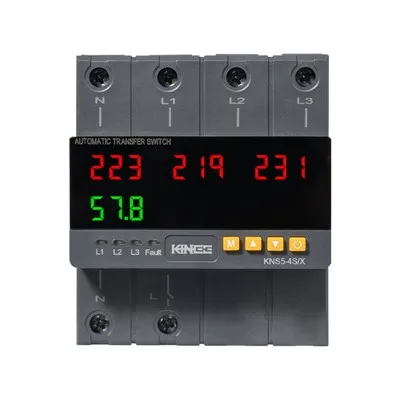
Measuring three – phase power with a multi – function meter is a straightforward process that can provide valuable information about the electrical system. By following the steps outlined in this blog, you can ensure accurate and reliable power measurements.
Manual Changeover Switch As a supplier of multi – function meters, we are committed to providing high – quality products and excellent customer service. Our meters are designed to meet the needs of different applications and are backed by our technical expertise. If you are interested in purchasing a multi – function meter for your three – phase power measurement needs, please contact us to discuss your requirements. We look forward to working with you to find the best solution for your power measurement and management needs.
References
- IEEE Standard for Instrument Transformers (IEEE C57.13 – 2016).
- International Electrotechnical Commission (IEC) 61036:2009 – Electricity meters for supply to domestic and similar installations – Particular requirements.
- Power System Analysis and Design, Fourth Edition, by J. Duncan Glover, M. Stanley Sarma, and Thomas J. Overbye.
Wenzhou Kinee Electrical Co., Ltd.
We are one of the most professional multi-function meter manufacturers and suppliers in China, featured by quality products and good price. Please rest assured to buy advanced multi-function meter made in China here from our factory. We also accept customized orders.
Address: Unit 1, Building 31, Wenzhou Wenbo Science and Technology Industrial Park, No. 706 Yanyun Road, Lingkun Street, Oujiangkou Industrial Cluster Area, Wenzhou, Zhejiang Province
E-mail: sandyma@kinee.net
WebSite: https://www.kinee.net/
