A pipe extrusion line is a complex and sophisticated manufacturing setup designed to produce pipes of various materials, sizes, and applications. As a supplier of pipe extrusion lines, I have witnessed firsthand the importance of understanding the main components that make up these systems. In this blog post, I will delve into the key elements of a pipe extrusion line, explaining their functions and how they work together to create high – quality pipes. Pipe Extrusion Line
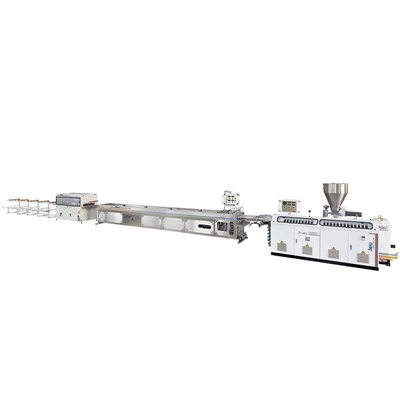
1. The Extruder
The extruder is the heart of the pipe extrusion line. It is responsible for melting and homogenizing the raw material, typically plastic polymers such as PVC (polyvinyl chloride), PE (polyethylene), or PP (polypropylene). The extruder consists of several sub – components:
- Hopper: This is where the raw plastic pellets are loaded into the extruder. The hopper has a controlled feeding mechanism that ensures a steady supply of material to the screw.
- Screw: The screw is a crucial part of the extruder. It rotates inside the barrel, conveying the plastic pellets forward. As the pellets move along the screw, they are subjected to increasing pressure and heat, which gradually melts the plastic. The design of the screw, including its length, diameter, and pitch, can significantly affect the melting efficiency and the quality of the extruded material.
- Barrel: The barrel surrounds the screw and provides a heated environment for the plastic to melt. It is usually equipped with heating bands that can be controlled to maintain the optimal temperature for the specific plastic material being processed. The barrel also has cooling systems to prevent overheating and to control the melting process precisely.
- Die Head: At the end of the extruder, the melted plastic is forced through the die head. The die head is designed to shape the molten plastic into the desired pipe profile. It can be customized to produce pipes of different diameters and wall thicknesses.
2. Cooling System
Once the pipe is extruded through the die head, it needs to be cooled rapidly to solidify its shape. The cooling system is an essential component in ensuring the quality and integrity of the pipe. There are two main types of cooling systems used in pipe extrusion lines:
- Water Cooling Tanks: These are the most common type of cooling systems. The extruded pipe passes through a series of water – filled tanks where it is cooled by direct contact with water. The water in the tanks is circulated and maintained at a specific temperature to ensure uniform cooling. The length and number of water cooling tanks depend on the pipe diameter, wall thickness, and the type of plastic material.
- Air Cooling: In some cases, air cooling is used in combination with water cooling or as a secondary cooling method. Air cooling is achieved by blowing cool air over the surface of the pipe. It is particularly useful for thin – walled pipes or for materials that are sensitive to rapid temperature changes.
3. Sizing Unit
The sizing unit is used to ensure that the extruded pipe has the correct diameter and wall thickness. It typically consists of a series of calibration sleeves or rings that the pipe passes through. These sleeves are precisely sized to grip the pipe and maintain its shape as it cools. The sizing unit also helps to remove any excess plastic and smooth the outer surface of the pipe. There are two main types of sizing methods:
- Vacuum Sizing: In vacuum sizing, the calibration sleeve is connected to a vacuum system. The vacuum creates a suction force that pulls the pipe against the inner surface of the sleeve, ensuring accurate sizing. Vacuum sizing is commonly used for PVC pipes and provides excellent dimensional accuracy.
- Pressure Sizing: Pressure sizing involves applying pressure inside the pipe to force it against the outer surface of the calibration sleeve. This method is often used for PE and PP pipes and can achieve good results in terms of pipe roundness and wall thickness distribution.
4.牵引系统
The haul – off unit is responsible for pulling the extruded and cooled pipe through the extrusion line at a consistent speed. It consists of a set of grippers or belts that hold the pipe firmly and move it forward. The speed of the haul – off unit is carefully controlled to match the extrusion speed of the extruder. If the haul – off speed is too fast, the pipe may stretch, resulting in a reduced wall thickness. Conversely, if the speed is too slow, the pipe may accumulate, leading to irregularities in the pipe’s dimensions.
5. Cutting Unit
Once the pipe has reached the desired length, it needs to be cut. The cutting unit is designed to make clean and precise cuts on the pipe. There are several types of cutting methods used in pipe extrusion lines:
- Saw Cutting: This is one of the most common cutting methods. A circular saw blade is used to cut through the pipe. Saw cutting is suitable for a wide range of pipe materials and diameters. The saw blade can be customized to achieve different cutting qualities and speeds.
- Shear Cutting: Shear cutting involves using a sharp blade to cut the pipe by applying a shearing force. This method is often used for thin – walled pipes or for high – speed cutting applications.
- Laser Cutting: Laser cutting is a more advanced cutting method. It uses a high – energy laser beam to melt and vaporize the pipe material, resulting in a clean and precise cut. Laser cutting is particularly useful for pipes with complex shapes or for materials that are difficult to cut using traditional methods.
6. Stacking and Packaging Unit
After the pipes are cut, they need to be stacked and packaged for storage and transportation. The stacking unit arranges the pipes in an orderly manner, either in bundles or on pallets. The packaging unit then wraps the stacked pipes with protective materials such as plastic film or cardboard to prevent damage during handling and shipping.
How the Components Work Together
All these components work in harmony to produce high – quality pipes. The extruder melts and shapes the plastic material into a continuous pipe. The cooling system then solidifies the pipe, while the sizing unit ensures its correct dimensions. The haul – off unit pulls the pipe through the line at a consistent speed, and the cutting unit cuts the pipe to the desired length. Finally, the stacking and packaging unit prepares the pipes for distribution.
The coordination between these components is crucial. For example, the extrusion speed of the extruder needs to be matched with the haul – off speed to avoid stretching or accumulation of the pipe. The cooling rate also needs to be carefully controlled to prevent internal stresses and cracks in the pipe.
Why Choose Our Pipe Extrusion Lines
As a supplier of pipe extrusion lines, we understand the importance of each component in the system. Our pipe extrusion lines are designed with high – quality materials and advanced technology to ensure reliable performance and excellent product quality. We offer customized solutions to meet the specific needs of our clients, whether they are producing small – diameter pipes for plumbing or large – diameter pipes for industrial applications.

Our team of experienced engineers and technicians provides comprehensive pre – sales and after – sales services. We can help you select the most suitable components for your pipe extrusion line, install and commission the equipment, and provide training and technical support throughout the operation of the system.
Pelletizing Line If you are looking to invest in a pipe extrusion line, we invite you to contact us for a detailed consultation. We are committed to helping you achieve your production goals and providing you with the best possible solutions for your pipe manufacturing needs.
References
- "Plastics Extrusion Technology" – A comprehensive book on the principles and practices of plastic extrusion.
- Industry reports on the latest trends and developments in pipe extrusion technology.
- Technical documentation from leading manufacturers of pipe extrusion line components.
Zhejiang Jwell Pipe Equipment Co., Ltd.
As one of the most professional pipe extrusion line manufacturers and suppliers in China, we’re featured by quality products and good price. Please rest assured to buy cheap pipe extrusion line in stock here from our factory. Customized orders are welcome.
Address: No.128 Qingfeng Road, Xieqiao Town, Haining City, Jiaxing City, Zhejiang Province
E-mail: salaa@jwell.cn
WebSite: https://www.jwell-pipe.com/
